Introduction
Medical Disclaimer: This article is for informational purposes only and does not constitute medical advice. The choice between GLP-1 medications requires individualized assessment by a qualified healthcare provider.
The two heavyweight champions of GLP-1 weight loss — Ozempic (semaglutide) and Mounjaro (tirzepatide) — dominate the conversation in 2026. But the weight loss injectables landscape now includes several options: liraglutide (Saxenda, an older daily GLP-1), semaglutide (Ozempic/Wegovy, weekly), and tirzepatide (Mounjaro/Zepbound, weekly dual-agonist). Which one should you choose?
This comparison is based on head-to-head clinical trials, real-world data, and 2026 pricing and insurance information. We’ll cover effectiveness, side effects, cost, and practical considerations to help you make an informed decision with your doctor.
Quick Comparison: At a Glance
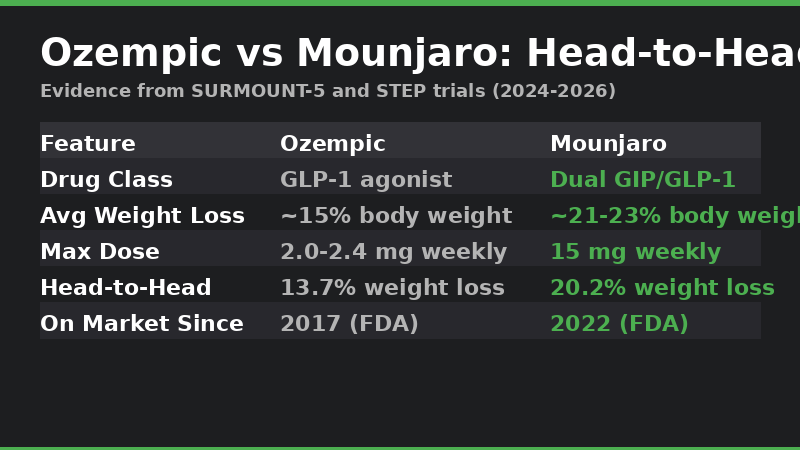
| Feature | Ozempic (Semaglutide) | Mounjaro (Tirzepatide) |
|---|---|---|
| Drug Class | GLP-1 receptor agonist | Dual GIP/GLP-1 receptor agonist |
| Manufacturer | Novo Nordisk | Eli Lilly |
| FDA Approved For | Type 2 diabetes (2017); Weight loss as Wegovy (2021) | Type 2 diabetes (2022); Weight loss as Zepbound (2023) |
| Dosing Frequency | Once weekly | Once weekly |
| Max Dose for Weight Loss | 2.4 mg (Wegovy) | 15 mg (Zepbound) |
| Average Weight Loss at Max Dose | ~15% of body weight | ~21-23% of body weight |
| Administration | Prefilled pen | Single-dose pen (autoinjector) |
Effectiveness: Mounjaro Wins — But by How Much?
The SURMOUNT-1 Trial (Mounjaro/Zepbound)
In the landmark SURMOUNT-1 trial, participants taking the highest dose of tirzepatide (15 mg) lost an average of 22.5% of their body weight over 72 weeks. At the 10 mg dose, average weight loss was 21.4%.
The STEP Trials (Ozempic/Wegovy)
In the STEP 1 trial, participants on semaglutide 2.4 mg lost an average of 14.9% of body weight over 68 weeks.
Head-to-Head: SURMOUNT-5
The first direct head-to-head trial (SURMOUNT-5, published 2024) compared tirzepatide and semaglutide specifically for weight loss. The results:
- Tirzepatide group: Average weight loss of 20.2%
- Semaglutide group: Average weight loss of 13.7%
- Difference: Tirzepatide users lost approximately 47% more weight
What this means in real terms: For a 220-pound person, Mounjaro might help you lose about 44-49 pounds, compared to 30-33 pounds with Ozempic — a difference of roughly 14-16 additional pounds.
Why Is Mounjaro More Effective?
Mounjaro’s advantage comes from its dual mechanism of action:
- Ozempic activates only GLP-1 receptors
- Mounjaro activates both GLP-1 and GIP receptors
GIP (glucose-dependent insulinotropic polypeptide) enhances the body’s natural insulin response and may have independent effects on fat metabolism and appetite suppression. This “two-for-one” approach appears to produce meaningfully better results for most patients.
Side Effects: Similar Profiles, Different Intensity?
Both medications share a similar side effect profile — primarily gastrointestinal. However, the pattern differs:
Ozempic Tends to Cause:
- More nausea at initiation
- Constipation is more common than diarrhea
- “Ozempic face” (facial fat loss) more discussed in patient communities
Mounjaro Tends to Cause:
- More diarrhea than constipation
- Slightly higher rates of vomiting at higher doses
- Appetite suppression described as more “complete” by patients
What the Data Shows
| Side Effect | Ozempic (Semaglutide) | Mounjaro (Tirzepatide) |
|---|---|---|
| Nausea | 20-44% | 12-33% |
| Diarrhea | 8-30% | 12-33% |
| Vomiting | 5-24% | 5-20% |
| Constipation | 3-24% | 6-17% |
| Gallbladder events | ~1.5% | ~1-2% |
The takeaway: Individual response varies dramatically. Some people tolerate Ozempic better, others prefer Mounjaro. There’s no universal “better” side effect profile — it’s personal.
Cost and Insurance: The Deciding Factor for Most People
2026 List Prices (Without Insurance)
| Medication | List Price (Monthly) |
|---|---|
| Ozempic | ~$935-970 |
| Wegovy (weight loss branded) | ~$1,350 |
| Mounjaro | ~$1,070 |
| Zepbound (weight loss branded) | ~$1,060 |
Insurance Coverage Reality
As of 2026:
- Type 2 diabetes: Both Ozempic and Mounjaro have broad insurance coverage when prescribed for diabetes. Copays range from $25-80/month with commercial insurance.
- Weight loss (non-diabetic): Coverage is improving but still inconsistent. Wegovy and Zepbound are covered by approximately 40-50% of commercial plans — up significantly from 2023-2024.
- Medicare: Does NOT cover medications specifically for weight loss. Coverage for diabetes is standard under Part D.
Savings Programs
Both manufacturers offer savings cards:
- Novo Nordisk (Ozempic/Wegovy): Up to $500 off per month for commercially insured patients
- Eli Lilly (Mounjaro/Zepbound): Savings card can reduce cost to as low as $25/month for eligible commercially insured patients
The Real-World Experience: What Patients Say
From Reddit and patient forums (2025-2026):
“Switched from Ozempic 2mg to Mounjaro 10mg. Lost an additional 12 pounds in 2 months after plateauing on Ozempic for 6 months. The appetite suppression is definitely stronger.” — r/Mounjaro user
“Ozempic made me nauseous for the first 6 weeks but then it leveled off. Down 45 pounds in 8 months. I’m happy and not switching.” — r/Ozempic user
“Mounjaro has worse GI side effects for me personally. I had to go back to Ozempic.” — r/GLP1 user
The pattern: Mounjaro tends to produce more weight loss, but some people find the side effects harder to tolerate. Individual biology matters enormously.
Which One Should You Choose?
Choose Ozempic If:
- You want a well-established track record (on the market since 2017)
- Your insurance covers Ozempic but not Mounjaro
- You prefer the multi-dose FlexTouch pen
- You’re sensitive to GI side effects and want a gentler start
- Your primary goal is diabetes management with weight loss as a secondary benefit
Choose Mounjaro If:
- Maximum weight loss is your top priority
- You haven’t responded well to Ozempic (plateau)
- Your insurance covers both equally
- You’re comfortable with a newer medication
- You want the dual mechanism (GIP+GLP-1) for potentially better metabolic effects
The Bottom Line
Mounjaro is the more effective weight loss medication on average — producing approximately 47% more weight loss than Ozempic in head-to-head trials. However, the “best” medication is the one that:
- Your insurance covers
- You can afford
- You tolerate well
- Your doctor recommends for your specific health profile
Many patients start with Ozempic (due to broader insurance coverage and longer track record) and switch to Mounjaro if they plateau or want stronger results.
Talk to your doctor about which option makes sense for your personal health goals, insurance situation, and medical history.
References
- Jastreboff AM, et al. “Tirzepatide Once Weekly for the Treatment of Obesity.” New England Journal of Medicine. 2022. PMID: 35658024
- Wilding JPH, et al. “Once-Weekly Semaglutide in Adults with Overweight or Obesity.” New England Journal of Medicine. 2021. PMID: 33567185
- Aronne LJ, et al. “Tirzepatide as Compared with Semaglutide for the Treatment of Obesity.” New England Journal of Medicine. 2025. PMID: 40353578
- GoodRx and manufacturer pricing data, June 2026. goodrx.com
Last reviewed: June 14, 2026


